
Products

World-Class Fuel Catalyst Technology

Patented in the US, EU, Australia and Canada. A proven way to cut exhaust emissions from equipment you already run — no modification, no capex.

Our fuel catalyst is an iron-based combustion catalyst supplied in solid form and dosed directly into the fuel tank — diesel or petrol. It improves the completeness of combustion in the engine, cutting soot, carbon monoxide and unburned hydrocarbons and reducing fuel consumption. SGS analysis confirms treated fuel remains within EN 590 and EN 228 specification, and the technology is protected by patents in the US, EU, Australia and Canada.

Dosing & application
1 kg
Treats up to 152,000 litres of fuel

Add a bag to the fuel tank before each refuelling — or mix the whole dose into a bulk tank beforehand. The powder dissolves completely within minutes and becomes part of the fuel.

The catalyst’s power

More complete combustion, measured where it shows up in the stack:

80%
Solid particulate emissions (black smoke)
80%
Unburned hydrocarbons (HC)
50%
Carbon monoxide (CO)
10%
Fuel consumption
10%
CO2, in direct proportion to fuel saved

All figures are “up to” — upper bounds, not guaranteed outcomes.

These are upper-bound figures. Results are governed by engine condition, load profile and baseline combustion quality — the largest reductions occur on older, harder-worked or visibly smoking units, and the smallest on new, well-maintained engines. Expect a settling period of several hundred operating hours.

On NOx

Reported reductions range from 5% to 30% depending on engine and duty cycle. The catalyst does not lower average combustion temperature; it levels out temperature peaks within the chamber. Because NOx formation is exponentially sensitive to temperature, suppressing those peaks reduces NOx even as total heat release improves. This is the same principle used in low-NOx burner design.

On SOx

Sulphur oxide output is set by the sulphur content of the fuel, not by how the fuel burns. Reducing fuel consumption reduces SOx in exact proportion — so a 10% fuel saving is a 10% SOx reduction, and no more. If SOx compliance is your binding constraint, fuel sulphur specification is the lever.
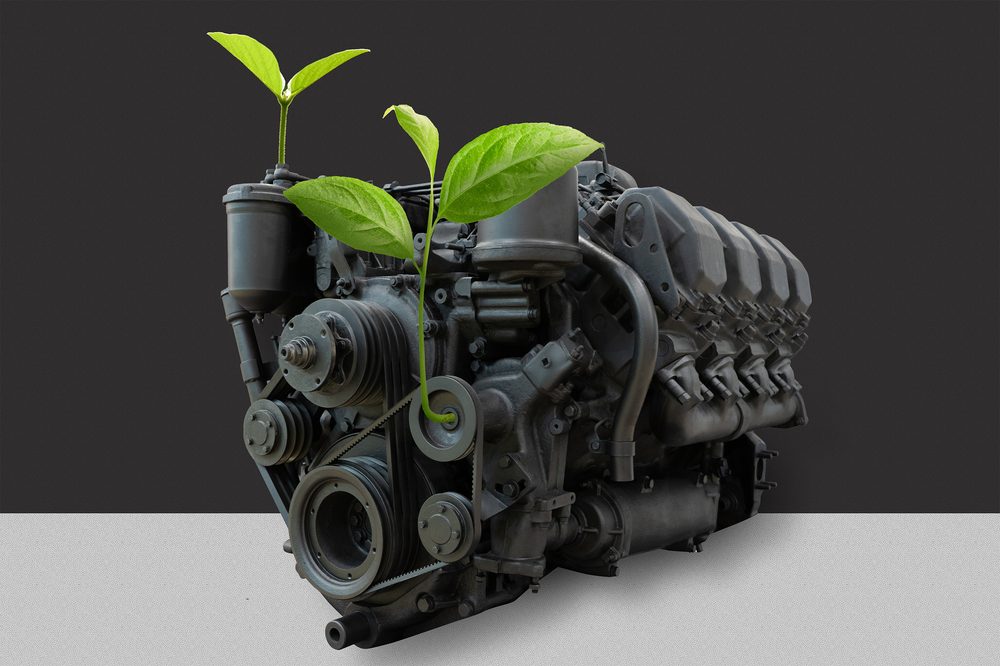
Fuel catalyst engine technology

Why it works

Up to 80% reduction in solid particulates, carbon monoxide, benzene and aldehydes
Fully compliant with all fuel standards and OEM specifications
Significant reduction of black smoke from exhaust
Up to 10% lower fuel consumption, cutting CO2 emissions by the same margin
Extends the service life of engines and exhaust systems
Lowers maintenance costs and reduces equipment downtime
Cleans and improves performance of major engine components
Fewer engine malfunctions and longer engine life — especially for construction equipment, oil rigs and industrial machinery

Industries it serves

Anywhere diesel or petrol equipment runs, the catalyst has a job to do:

Oil Drilling Rigs
Mining & Construction
Power Plants
Ships & Vessels
Generators

What it will not do

  • It will not repair a mechanically defective engine. Injector, turbo or timing faults need fixing, not dosing.
  • It is not a NOx compliance solution on equipment without aftertreatment.
  • It is not a substitute for aftertreatment where regulation requires it.
  • On new, well-tuned engines with clean stacks, the measurable benefit may be small.
  • Results take time — expect a settling period of several hundred operating hours.

The evidence behind these figures

  • SGS (ISO 17025 accredited), 2023 — treated diesel and petrol remain within EN 590 and EN 228: density, viscosity, flash point, distillation, cetane and calorific value unchanged.
  • MVT Solutions, BF Goodrich Test Track, Texas, 2022 — instrumented 1,100-mile test, 2019 Cummins X15.
  • MAN authorised test workshop, Austria, 2022 — 28-day opacity measurement, MAN Euro-5.
  • Utelite Corporation (Holcim group), USA — 8,000 gallons treated against 8,000 gallons untreated on matched CAT haul trucks and loaders; continuous customer for eight years.
  • Ghana Manganese Company — 2021 pilot on mining fleet and generators, scaled up in 2022.